Showing posts with label literature. Show all posts

Tuesday, April 7, 2020

Kappa by Akutagawa Ryūnosuke, Foreword

FOREWORD

At a certain asylum there is a patient, number twenty-three, who will tell his story to anyone. He's at least thirty, but no one appears so youthful as a madman. His experiences the first half of his life -- well, that's not important. These days he just sits, arms around his knees, sometimes glancing out the window. Outside the iron bars is a single oak tree without leaves and the snow-clouded sky.
He told his long story to the director, Dr. S, and myself. He was expressionless for the most part, but if saying "I was surprised," for example, his head would jerk up.
I believe I’ve recorded his story accurately. If you'd like to know more, ask at S--- Institution in ---- neighborhood of Tokyo. Patient twenty-three will greet you politely, direct you to a wooden chair, and with a melancholy smile repeat his tale in a soft voice. When he finishes -- how his face changed is still stuck in my memory -- he leaps to his feet, hands in fists, shouting, "Get out, you villain! You're a stupid, jealous, shameless, stuck-up, cruel, selfish animal, aren't you? Get out of here!"

Kappa by Akutagawa Ryuunosuke, Chapter One

CHAPTER ONE

Three summers ago, rucksack on my back, I decided to hike from Kamikouchi hot springs resort up to Mt. Hotaka. As you know, the only way is along the Azusa River. Since I'd climbed the mountain before, as well as Yariga Peak, I set out without a guide in the morning fog. If it didn’t clear up, I would have been blinded to the scenery around me. It seemed to grow thicker. I’d only walked an hour before I thought about returning to the hot springs resort in Kamikouchi. But I thought if I reached a higher altitude, the fog would lift.
It deepened every minute. "If I just climb a bit more!" I thought, and breaking away from the river, started through a bamboo grove.
All I could see was the dense fog, at times broken by a fluttering moth or drooping fir tree branch. Grazing horses and cows appeared and disappeared in a heartbeat. I started to become tired and hungry, and even worse my clothes were heavy with dampness. Finally I gave up, and following the sound of trickling water, felt my way down into the valley.
I sat on a rock to have some food. It took about ten minutes to open a can of corned beef, and make a fire from twigs. In the meantime the fog was steadily clearing, as though proving it had beaten me. Gnawing a piece of bread, I glanced at my watch. Already twenty minutes past one. What shocked me more, however, was the reflection in its crystal of a strange face. I looked over my shoulder, and saw for the first time ever a kappa. Perched on a rock behind me, it had one arm around the white trunk of a birch, the other hand shielding its eyes. It stared back at me with a curious expression.
I was so taken aback, I couldn't move. The kappa also seemed to be astonished, and froze, hand still upraised. Then I jumped up and towards the kappa, who fled in the same instant. Well, I thought it did -- it certainly disappeared. I looked around and through the tall grass, and spotted it a ways off, poised to flee. I couldn't blame it.
What truly surprised me was its color. Before, when it had stood on the rock, it was gray -- now, from head to toe, it was green.
"Damn it," I said, and again leapt for it, and of course it ran away. For over thirty minutes I chased it headlong through the tall grass and over rocks.
The kappa could run quite fast, even more than a monkey. Often, as though in a dream, I thought I'd lost it, or slipped and fell down. But then we ran into a massive chestnut tree, under which an ox with fearful horns and red eyes was grazing. The kappa let out a strange cry and dove for a patch of tall grass.
"I’ve got it, " I said to myself, and jumped after. There was some kind of unseen hole there. My fingers just brushed the smooth shell of the kappa as I fell headlong into profound darkness.
At such a terrible moment, the brain takes refuge in trivial thoughts. I thought of Kappa-bashi, a bridge near the Kamikouchi resort. I'm not sure what happened then -- I glimpsed a brilliant flash like lightning, and blacked out.

Kappa by Akutagawa Ryuunosuke, Chapter Two

CHAPTER TWO

When I regained consciousness, I was lying face up surrounded by kappa. One, kneeling beside me, was pressing a stethoscope to my chest, a pair of pince-nez on his beak. Meeting my eyes, he gestured for there to be quiet, then made a quack quack noise to someone behind him. Two kappa came up carrying a stretcher. Lifting me onto it, they bore me through the middle of a great crowd of kappa and into some kind of village. To either side of me the street could hardly be distinguished from the Ginza. There were rows of beech trees, and in their shade various stores, with vehicles passing between them.
Before long, the stretcher carrying me turned onto a narrow lane, and we entered a house. I later learned this belonged to the pince-nez wearing kappa from before, who turned out to be a doctor named Chak. He put me in a tidy bed and gave me a dose of clear medicine. I let him do whatever he wanted, for my joints hurt so much I was unable to move.

Every day Chak gave me a medical examination two or three times. Then on the third day, the very first kappa I had seen -- a fisher named Bagg -- came to ask how I was. Kappa know more about us humans than we do about them. That's because they are more likely to capture us than we are to catch one of them. Capture isn't quite the right word, but I was far from the first human to enter the land of kappa. Some even spent their whole lives there. I asked why this was. In the country of kappa, a human being is such a marvel that they don't have to work but can simply enjoy life. Actually, according to Bagg, a sailor had once come and taken a female kappa as his wife. Apparently she was not only quite good-looking for her species, but also had bewitched him.
After resting there about a week, it was decided that I would be allowed as a protected resident to live next door to Chak. My house was small in comparison, but quite elegant. There wasn't actually a great difference between this country's civilization and the land of human's civilization -- or at least Japanese civilization. In a parlor facing the main street, there was a small piano in the corner, and framed paintings hung on the wall. As all houses must have, there was a table and chairs but they were made for kappa proportions, so it was like entering a child's room and a bit awkward for me.
When dusk fell, Chak and Bagg would visit me in this room and teach me the kappa language. Not just the two of them -- every kappa who was curious about me came to call. One, named Gael, was the president of a glass making factory, and visited Chak every day to have his blood pressure checked. But the first half month, the  one I came to know most intimately was Bagg.

One warm, humid day, I was sitting at the table chatting with Bagg. Suddenly he fell quiet, and he stared at me, his big eyes growing even larger.
I said to him, "Quack, Bagg, quo quel quan?" In Japanese this would be translated as, "Oi, Bagg, what's wrong?"
He was silent for a moment. Then he stood abruptly, and his tongue flicked out, exactly as a frog's does. Feeling uneasy, I also stood, and thought about fleeing from the room. Fortunately, just at that moment the doctor Chak showed up.
"Well, Bagg, what are you doing?
Chak glared at Bagg over the top of his glasses, and Bagg looked remorseful, touched his head several times while apologizing: "I am extremely sorry. I only meant to play a little prank on the master of the house. Please excuse my behavior."
Then he turned to me, and begged my pardon as well.

Kappa by Akutagawa Ryuunosuke, Chapter Three

CHAPTER THREE
Until this point, I haven't explained much about the kappa. There continues to be the question about whether a creature such as kappa can even exist. But, since I have myself lived among them, there is absolutely no room for doubt. If we are describing them as an animal, the hair on their head is short, their hands and feet are webbed as described in the book “Studies on Kappa”. They are no taller than three feet. According to Chak, they usually weighed from 20 to 30 pounds, although a very large one might be up to 50. Right in the middle of their head was a bowl, which gradually hardened with age. There was a marked difference between the bowl of older Bagg and that of young Chak. 
But the most wondrous thing was the skin color of the kappa. Unlike us humans, kappa skin did not stay a single color. It changed to match their surroundings. That's why when I'd seen one on the grass it had been green, and on the rock gray. Of course it is not only kappa who do this, chameleons are also able. Possibly kappa skin tissue was somehow related to chameleon's. I learned that it was said Western kappa were green and Eastern kappa were red. Except for the time I'd seen Bagg change, I didn't see it happen again.
Moreover, beneath their skin was a thick layer of fat, because this underground world was very cold compared to above (about 50 degrees Fahrenheit). They knew nothing of kimono 
Of course the kappa wore glasses or carried a cigarette case or wallet, but they had a pouch like a kangaroo so it was very convenient for carrying these things. 
What was odd to me was that they didn’t even wear a loincloth. When I asked Bagg why this was, he threw back his head with laughter, then answered, “It is odd to us that you do hide it.”

Kappa by Akutagawa Ryuunosuke, Chapter Four

CHAPTER FOUR
Gradually I learned all the words kappa used in everyday life. This included their manners and customs.The most confusing is that the kappa found ridiculous what us humans were earnest about, while themselves taking seriously things humans found absurd. This was one of their customs. 
For example, we humans attach significance to justice and humanity, but when I asked a kappa about these things they'd laugh uproariously. In short, their idea of humor and our sense of humor had absolutely nothing in common. One time I tried to discuss birth control with the doctor Chak. He laughed so hard his pince-nez fell off. I was perturbed, and I tried to quiz him on what was so funny, but he was unable to come up with an answer. He answered something like this -- I might be wrong about the exact wording, as I wasn’t fluent yet.
“For parents to even consider such a thing is strange. It’s too self-centered of them."
In turn, to a human there is nothing stranger than the way a kappa gives birth. Shortly after that conversation, I went to Bag’s house when his wife was due. Like us when we give birth, kappa have a doctor and nurse in attendance. However, during labor, the father speaks into the mother’s private area as though into the mouth of a telephone, saying “If you want to be born into this world, think about it carefully before giving an answer.” Kneeling, Bagg said this many times over. Then he took a break to gargle some mouthwash. The child inside his wife seemed to be concerned, for it said in a quiet voice,
“I would rather not be born. For starters, if I inherit your mental illness it will be difficult. Furthermore, I believe that existence as a kappa is not a good thing.”
Bag scratched his head when he heard this reply. However, the midwife who was there immediately thrust a thin glass tube inside his wife and injected some kind of liquid. The woman sighed with relief, and her great belly shrunk like a deflating balloon.
This kind of exchange is possible because kappa children can walk and talk immediately. Chak informed me one had been known to give lectures on the existence or non-existence of God only 26 days after birth. However, that child had died in his second month.
On a different subject, after living in that country for a couple of months, I saw a large poster on a street corner. It portrayed a dozen kappa, some blowing trumpets, some bearing swords. Above them were spiral characters like clock springs. I couldn’t translate the details, but the student Lapp who was walking with me read it out to me in a loud voice so I could take notes.

Calling genetic volunteers (followed by three exclamation points)
Healthy male and female kappa (three exclamation points)
In order to eradicate evil genetics
Must wed the unhealthy male and female kappa (three exclamation points)

I said to Lapp that this seemed impractical. Then not only he but other kappa who had gathered around us laughed out loud.
“You think so? But from what you’ve said of your home country, it is just the same. Upper class young men may fall for their housemaids, while the young ladies fall for their drivers. What is the reason for that? It’s because they are subconsciously driven to strengthen their weak genetics. I would say our volunteers are actually more admirable than some humans who will work themselves to death laboring on the railroad.”
Lapp spoke seriously but his great belly still shook with laughter. In the hubbub, I hadn’t noticed a kappa sneak up beside me until he snatched my fountain pen. Because of the slippery skin, a kappa is difficult to grab. He oozed from my grasp and, bent almost parallel to the ground, zoomed away like a mosquito.

Kappa by Akutagawa Ryuunosuke, Chapter Six

CHAPTER SIX

In fact, romance among kappa is quite different from romance among humans. The female looks for a male quickly, and upon finding him does not think twice. The most straight-forward female will chase the male. I myself saw a female in mad pursuit. Not only that, but her parents and siblings followed. The male looked miserable. If he were lucky enough to escape, he would still be laid up for two or three months.

I was reading an anthology of Tock's poetry at home one day, when the student Lapp came running in. He collapsed on my bed, panting.

"This is horrible! She'll catch hold of me!"

I dropped the book at once and locked the door. Peering through the keyhole, I could see a short female with a painted face. She loitered outside my door. Lapp slept on my floor for several weeks after that. His beak grew rotten and finally fell off.

Then again, sometimes there is a male who chases a female, but only because she entices him. I once saw a male running after a female who, in the midst of her escape, would occasionally pause deliberately to crawl on all fours. Then when the time was right, she let herself be caught as though worn out. He embraced her and they rolled around for a while. When he finally got up, he had an expression of disappointment or regret -- I can’t describe it exactly.

But that was all right. There was another small male with a female, as said before, performing a sexy run away. Then a bigger male walked by, snorting. When the female saw him, she cried out, “Oh no, please help! He’s trying to kill me!” Of course he grabbed the smaller male and threw him into the middle of traffic. The small one grasped at empty air with his webbed hand a few times, then finally died. By then, the female was grinning with her arms around the neck of the larger male.

The male kappa I was acquainted with had the experience of being chased. Even Bagg, who had a wife and children. He’d even been caught a couple of times. Only the philosopher Magg ( who lived next door to Tock) had never had the misfortunate. This might be because he was quite ugly for a kappa, but also because he stayed at home and rarely went out.

I sometimes went to Magg’s house to chat. He was always in a very dim room, lit only by a lamp with a shade in seven different colors. He read a thick book at a tall desk, and we discussed romance among Kappa.

“Why doesn’t the government crack down on females chasing males?”

“Partly because there are few females among the officials. Females are stronger and more possessive, so if more of them were in charge there would be less chasing than there currently is, But perhaps if there were females in government they would chase even their comrades, the male officials.”

“So your kind of lifestyle is the happiest.”

Magg left his chair, and taking my hands said with a sigh, “you’re not one of us, so you can’t understand. But I also long to be pursued by a terrifying female.”

Kappa by Akutagawa Ryuunosuke, Chapter Seven

CHAPTER SEVEN

I went to several of Tok's recitals, but the one I will never forget was the third time. The hall was no different from ones you'd see in Japan. The stadium seating was filled with three or four hundred kappa, holding programs, eagerly listening. I sat with Tock, his mate, and the philosopher Magg in the front row. After a cello solo, a kappa with strangely narrow eyes arose, casually holding some music books. This was the famous composer named Craback, according to the program. But I didn't need to learn it from there -- I knew him from Tock's Super-kappa club.

"Lied -- Craback" (Programs in this country mainly used German.)

Craback bowed to enthusiastic clapping, then silently approached the piano. He began to play his own composition. Craback, as Tock had said, was a genius without peer in the entire land. I'd been interested in Craback's music, so I watched him play avidly. Tock and Magg were in a trance even greater than mine. But a beautiful (at least, by kappa standards) female was gripping her program, and from time to time stuck her tongue out. According to Magg, she had tried to capture Craback ten years before and even to this day considered him an enemy.

Craback played with passion filling his entire body, battling with the piano. Then suddenly throughout the hall rang the cry "Desist!" I turned to see a very tall police-kappa in the back row. He stood very calmly with a straight back, and spoke again, "This performance must desist." Then --

Then chaos ensued.

"Police oppression!" "Craback, play! Play!" "Idiot!" "Brute!" "Get out of here!" "You won't beat us!" yelled kappa standing on their chairs, hurling programs, even throwing cider bottles and chewed-on cucumbers. Amazed, I tried asking Tock what was going on. But he was so excited he was also standing on his chair, yelling "Craback, play! Play!" Besides which, his mate shouted "police tyranny!"

I had no choice but to ask Magg, "What's happening?"

"This? It happens all the time in this country. It's how art originates."

Something came flying and Mag ducked into his shell. He calmly continued, "In general, anyone can observe what a painting or book means. So their sale or showing is not prohibited. Musical performances, however, are often banned. No matter how moving a piece might be, it can't be understood by a kappa without an ear for it."

"Doesn't that officer have ears?"

"That's a very good question. Possibly the song just reminded him of his heart-beat when he's intimate with his wife."

During our conversation, the chaos had grown even more. Craback had turned back to his piano, ignoring us arrogantly. However, it couldn't be helped that objects flew in his direction and he had to duck every few seconds. In general, he managed the air of a great musician, looking around with his fine eyes. I, meanwhile, was using Tock's shell as a shield, but kept on talking to Mag.

"Isn't this an extreme form of censorship?"

"Well," said the philosopher. "It's more advanced than any other country. Take yours, for example, only last month they --"

But just then, a bottle came hurtling through the air and struck him on the head, and after uttering "quack!" he fell unconscious.

Kappa by Akutagawa Ryuunosuke, Chapter Eight

CHAPTER EIGHT

I was oddly fond of the glass company president, Gehru. He was a capitalist's capitalist. Not to be rude, but among kappa he had the largest belly. His wife resembled a lychee and his children cucumbers, but they seemed to have good fortune in life. With a judge named Pepp and the doctor Chak I went to dinner at Gehru's house. Taking his letter of introduction, I visited various factories where Gehru had connections.

I was most interested in a certain publishing house. A young engineer kappa showed me inside, how it was powered by hydroelectricity. When I gazed at a huge machine, I wondered at how industrial progress was coming in the kappa world. In one year, they could print seven million books. But what surprised me more was not the number of books, but how simple it was to produce them. To make a book in this country, paper, ink, and an ash-gray powder was poured into a funnel. In less than five minutes, these raw materials were turned into infinite books of various sizes.

I stared at a waterfall of books coming out. I asked the slouching engineer what the powder was. Standing before a glossy black machine, he answered in a monotone, "This? This is donkey's brain. Well, it's dehydrated and ground up. Its current value is two or three sen per ton.”

Of course the wonders of book printing was not all. There was also a painting factory and a music factory that were run the same. Gehru told me that in this country, an average of seven or eight hundred machines were invented, able to mass produce faster than by hand. A few hundred former factory workers had been let go. It had gotten to be so that every morning when you read the newspaper, another strike would be announced. I found this strange, and when invitted to dinner with Peppu and Chack I asked why.

"It's so everyone can eat,” Gehru said casually after dinner, lighting a cigar.

But I couldn't understand what he meant by “to eat.” Then pince-nez wearing Chack explained more thoroughly for my benefit.

"Those factory workers are killed, and turned into meat for everyone. Look at the newspaper. This month exactly 64,765 workers were let go, so meat has become that much cheaper."

“The factory workers are killed to shut them up?"

"That's what comes of making a racket. It's the Worker Butchery Act." From behind a potted sapling, Peppu spoke with a bitter expression. Of course I felt uneasy. But Gehru was the head of the household, and Peppu and Chack also seemed to find it natural. Chack actually scoffed while speaking to me.

“Basically, the point is to eliminate the national problems of starvation and suicide. If one sniffs a little poisonous gas, there is barely any pain."

"But to eat that meat -- “

"Don’t get started on that. If that Magg were to hear you, he would laugh out loud. In your country, don't the daughters of the poor become prostitutes? If you grow indignant at the thought of butchering factory workers, it's only sentimentalism."

Gehru, listening to this exchange calmly, offered me a sandwich from the table. "Would you like some? This is also factory worker meat."

Of course I shrunk back. No, more than that. I fled from Gehru's parlor to the sound of Peppu and Chack laughing. No light could be seen in the houses I passed, and the night had grown stormy. In that darkness I returned to my dwelling, and began to vomit unceasingly. In the dark my vomit flowed like pouring ash.

Tuesday, May 31, 2011

“Maybe none of us really understand what we’ve lived through...”

After I’d acquired an interest in all things Japanese and before I actually came to the country, I would jump at the chance to get my hands on anything with a hint of it. Which is why I picked up “The Remains of the Day” by Kazuo Ishiguro. I soon realized that despite his name, he hasn’t lived in Japan since he was a child and is for all intents and purposes a British writer. Remains is even narrated by that staple of British literature, the Butler – and yet, in a strange way, Stevens struck me as an integrally Japanese character. He’s one of a dying breed – the dignified, loyal servant, and as he considers his own role in relation to those he has served, there’s a strong feeling of “shikata ga nai” (alternatively shouganai)– “it can’t be helped.” Stevens knows that the man he spent most of his life serving was not as honorable as he would attest – but it couldn’t be helped. Where else would he go, who else would he serve, what else would he do if he weren’t buttling?

Shouganai is a sentiment that is pervasive here, notably so since 3/11, and it can be at times a frustrating display of complacency(1)and heartbreaking calm in the face of adversity. Stevens’ sense of resignation becomes fatal in the characters from Ishiguro’s more recent work. I went to see on the draw of Andrew Garfield (and my love of all things Social Network) and ended up buying the book the second I left the movie theater. I rarely buy new English paperbacks here because they’re unreasonably expensive, but it was such a beautiful movie – the actors especially were brilliant – and I needed to know how it differed from the adaptation.

Usually I’d try not to spoil the plot of a movie for you, but the trailer reveals pretty much everything, and it’s not a suspense-heavy story, but rather relies on the characters. The three main characters start as children living in what appears to be an idyllic English boarding house. We soon realize that they are actually clones, created to provide organ donations that will lead to their early deaths.

If this were just about any other movie based on any other novel than an Ishiguro, there would be an inevitable chase scene where the doomed lovebirds make a desperate flight for freedom and are hunted down by The Man. And yet Never Let Me Go has the same sense of tragic acceptance that Remains of the Day does, that Japan itself has had these past few months. The only method of escape they consider is what they believe has been sanctioned – when that falls through they don’t seek an alternative. Because what else is there, really?

It can’t be helped.


(1)“But it can be helped,” an exasperated ex-pat friend once said to me when I used it in his presence. I was speaking to some mutual Japanese friends. While they nodded in agreement, he responded, “We can help it.”

Saturday, April 30, 2011

“Under the Cherry Trees” translation

It’s a bit late to post this, as the cherry blossom season has pretty much wrapped up here. However, I just remembered today that I’d started to try translating this short story a couple of years ago. It caught my attention because it has one of the best opening lines ever. I quickly gave up in frustration because my comprehension level was still too low. It’s extremely rewarding to have tangible proof of my improvement – this time I finished it up in a couple of hours.


~~~


Under the Cherry Trees (1928) by Kajii Motojirou (1901-1932)

桜の樹の下には ~ 梶井基次郎 英語 翻訳

There are bodies buried under the cherry trees!

This is something that I definitely believe. How else could those flowers bloom so magnificently? Because of that unbelievable beauty, I’d been uneasy for two or three days. But now, understanding has finally come to me. There are bodies buried under the cherry trees. This is something I believe.

For some reason, on the road I walk home every evening, something appeared clearly in my mind. Out of all the implements in my room, it had to be very tiny and flimsy, like the edge of a safety razor or something like that. You say you don’t understand – and after all, I don’t either. But there’s no doubt that all of this is related.

No matter what kind of flower a tree bears, when it reaches the state known as full bloom, a mysterious kind of atmosphere spreads in the air around it. It is like a top that spins so well it appears to be completely still, or the way a skillful musical performance always seems to be accompanied by an illusion. It is like the afterglow from being given a vision of incandescent reproduction. Unless it is striking at a person’s heart, it is a wondrous, vivid beauty.

But yesterday or the day before, it was just that which brought a terrible gloom into my heart. I felt that such a beauty was something unbelievable. On the contrary, I became anxious, and depressed. I felt empty. But now I understand at last.

You, try to imagine that beneath this glorious profusion of blossoms, a dead body is buried under each tree. I wonder if you can understand, then, why I am so ill at ease.

Horse-like corpses, dog- and cat-like corpses, as well as human-like corpses. All of them decomposing and filled with maggots, making an unbearable stench. And yet, a crystal-like liquid is also trickling out. The cherry tree’s roots, like a greedy octopus, holding them while its hair roots, like a sea anemone, soak up the liquid.

I can see it as though in a dream. The crystal liquid being sucked in and making a quiet procession through the plant tissues, somehow creating petals such as those, stamen such as those.

Why are you making that troubled face? Isn’t it a beautiful insight? It is as though with my gaze fixed I can finally see the cherry blossoms. Yesterday or the day before, I became free of the mystery that haunted me.

Two or three days ago, I climbed down into the valley, holding onto rocks as I went. Here and there mayflies were given birth from within the spray of water like Aphrodite, and I saw them soar into the valley’s sky. As you know, that is how they exquisitely wed. After walking a little while, I came across something strange. The water in the valley had dried up to form a small beach, except for a small puddle left behind. It was there, floating on the surface with a shimmer like accidentally spilled oil. What do you think was there? There were countless thousands of dead mayflies. They covered every inch of the water's surface, their wings overlapping each other. That was what was displaying the shimmer like light reflecting off oil. It was their graveyard after they finished spawning.

When I saw that, it felt as though something had struck my heart. Discovering that graveyard, I savored my cruel delight like a degenerate with an interest in dead bodies.

There was nothing else in that ravine that could give me pleasure. The warbler and the tit, the bright sunlight on the fresh buds, none of it was more than a vague impression. For me, tragedy is something essential. For the first time I feel clearly that there is equilibrium. My heart has a devilish thirst for gloom. My heart can only be calm when it has achieved complete melancholy.

You’re dabbing at your armpits – you’ve broken into a cold sweat. I am in the same state. It’s nothing to be ashamed of. Think of it as being just like the stickiness after climax, as our melancholy achieves completion.

Ah, there are bodies buried under the cherry trees!

I haven’t the slightest idea where this daydream of corpses came from, but now no matter how I shake my head it will not leave me, it has become one with the cherry trees.

Now is the time when, just as the village people have the right to spread a feast under the cherry trees, I am also in the mood to drink while looking up at the blossoms.


~~~


Haha. Oh, Japan… I don’t think I’ve felt so sorry for the referred-to recipient of a story since Rime of the Ancient Mariner or maybe Saki’s The Open Window. I can’t help but imagine this narrator cornering some terrified young guy on his tarp at a hanami party, and not letting him go until he hears the whole morbid theory. Eventually he’ll wander away, only to burst out in the occasional drunken refrain, “There are bodies buried beneath the cherry trees!” while everyone else gives him a wide berth.

Sunday, April 24, 2011

Our Courage, Chapter Eight

That night, Yamato couldn’t sleep.

Yuuri’s hand had been cold? Impossible...

Images from the day he had met Yuuri until now flashed through his head. At a time when everything in Less-Than city had taken Yamato aback, Yuuri had been the boss. Having the only gun, she’d been in control.

But Yuuri hadn’t been doing it only for herself. She’d used the deliveries she took to take care of the smaller children who couldn’t get any supplies for themselves.

That was the kind of person Yuuri was. Seemingly gruff and nihilistic, but in truth more gentle than anyone, more wounded than anyone, and more concerned about everyone in this village. That was the Yuuri that Yamato wanted to see smile again.

That guy Reiji had died two days after his hands turned cold. Did that mean Yuuri only had two days left?

It couldn’t be true, it couldn’t be -

He couldn’t quench the fear, and a sorrow began to spread in Yamato’s chest.

*

In the Headquarters, a tape was playing of a DJ’s cheerful voice being interrupted by a desperate cry. It was a recording of Yamato’s attempt to contact the outside world. But -

“There were some inquiries about the message, but we explained it as a prank.”

“This has gone too far,” the vice-minister’s eyes glittered.

A secretary stood and began to read a report.

“The Makuhara T-virus is caused by an organism, that causes death by preventing cell regeneration in the human body.”

“If that’s so, why is it only children can survive it?”

“There is an area of the DNA called Telomere that calculates age. As it replicates, the count becomes shorter. Our hypothesis is that the Telomere causes so much cell death that the infected person dies around the age of twenty.”

“Have you found a cure?”

“... No, not yet.”

As the other members of the board lowered their heads, there was a razor-edged gleam in the vice-minister’s eyes.

*

A cold north wind blew in that felt like it could peel your skin off.

Mori and Takeru stood by the school’s play equipment, unsmiling.

“Hey, Takeru, is Yuuri going to die? Is there anyway we can stop it? What should we do?”

Looking at Mori as he thought for a moment, Takeru finally opened his mouth. “Act normal, just keep doing what you always do.”

“I don’t know if I can...” Mori muttered.

Takeru didn’t know either. His heart was filled with worry, he wanted someone he could rely on.

But... Takeru corrected himself

That couldn’t be his biggest concern right now. More than that, he needed to be someone Yuuri herself could depend on. She couldn’t have the slightest idea of their concern. They had to show her that everything was normal. If that was the only thing he could do for her...

He entered the music room with heavy tread. Yuuri was alone, lying on the sofa and staring at a point in space.

“What is it?” she said, looking at his trying-to-look-natural expression.

“No-nothing, really, I was just wondering how you were.”

“What do you mean?”

“Just, you know, your condition...”

“I’m so-so,” she said, with the same expression as always.

Yamato also came in, seeming as if he also was worried about her.

“What is it?” she looked at both of them.

“Nothing in particular, just wondering how you were doing,” Yamato said, before Takeru dragged him away.

He muttered in the hallway, “Stop acting so strange!”

“Huh?” Yamato responded, looking at Takeru askance.

“Don’t come talking to her without any reason.”

“You did it, too.”

“Yeah, but...” Takeru said, and fell silent. He looked straight at Yamato as though deciding something. “Yamato?”

“Yeah?”

“Did you notice?” Yamato stared back, not getting Takeru’s meaning, and Takeru smiled bitterly. “No, you wouldn’t have. You’re too thick.”

*

When Yamato walked out into the schoolyard, he saw Suzuko doing laundry by herself. She smiled when she saw him.

“It’s going to be Christmas soon. Do you remember last year?”

Christmas? It was that season already... Yamato had totally forgotten. In this town, they were literally trying to survive day to day. Things like Christmas and New Year’s had nothing to do with survival.

But Yuuri might never see another Christmas.

Unaware of Yamato’s dark thoughts, Suzuko kept chattering.

“I was late for my curfew when we missed the last train, and my dad got so angry, yelling, “What time do you think it is!?” and you told him, “I don’t have a watch so I don’t know.” And he said, “Stop kidding around!”

Just then, Yuuri wandered by them with an vague air. She carried a white plastic bag, and her steps were uneven, as though each took all of her strength.

Yamato looked after her as she went, and Suzuko watched him do so.

*

Yamato caught up to Yuuri and took the bag from her. Inside were several glass bottles filled with gas.

“I’m going to burn it down, everything,” Yuuri muttered.

“If you start a fire, you’ll get shot at.”

“Don’t care. I’m going to die anyways. Doesn’t matter if it happens fast or slow.”

“Yuuri... you know?”

“It’s not like I wouldn’t figure it out I thought about what I could do for everyone, and this was the only thing.” She looked straight ahead, and spoke matter-of-factly.

“Why are you talking about this kind of thing?”

“Isn’t it hard for you? You were betrayed, isn’t it painful?”

“I guess, yeah, it was hard.”

“So that’s why, if I stayed silent and did nothing, it would be painful.”

Her tone and expression were gentle, but Yamato thought there must be a fire burning inside her.

“I’m not going to let you go through with something this dangerous.”

She said firmly, “There’s something I have to do.”

“What is it?”

“Get revenge on my mother’s enemy. She was killed... by Shibasaki...”

“Huh?” Yamato gasped. Yuuri’s enemy... was Shibasaki himself?

But suddenly, all the power left Yuuri’s body, and she swayed as though she were about to collapse. Without thinking, Yamato put an arm around her and held her up. She was freezing against his fingertips.

“I can’t let it go any more... I can’t die leaving it like this...” Yuuri murmured as though delirious to a stunned Yamato.

*

“Yuuri’s mother’s enemy?” Takeru’s voice raised in surprise.

Yamato, looking at Yuuri as she lay unconscious on the music room’s sofa, nodded. “I’d been thinking what to do to help Yuuri.”

“But talking about revenge...”

“It’s not like I’m going to kill Shibasaki. I couldn’t.”

“Then what?”

“I’ll get him to apologize to her,” Yamato said as though he’d been thinking hard, and Takeru scoffed.

“They’re not little kids, here.”

“It’s all I can do. I can’t let her do anything dangerous, so I’ll go.”

Saying this Yamato started to leave, but Takeru called him back.

“Wait a minute.”

“What for?”

“There is something else you can do for Yuuri.”

At Takeru’s words, Yamato looked back at him questioningly.

“Yuuri... likes you.”

“That’s ridiculous,” Yamato said with a small laugh.

“It’s not a joke, it’s the truth,” Takeru said, and took hold of Yamato’s shoulder with a serious expression. For a second, Yamato stood still as though struck by lightning. He remembered the day he’d first met Yuuri. That was right, he’d thought she was a woman until her words, “I’m not a girl,” and rewrote her representation of herself, and from those words until now he’d accepted that as the reality, but...

Knowing Yuuri’s hidden feelings for the first time, Yamato could only be silent.

“So because of that, if you could stay with her. And... if you could like her back. I’m asking you,” Takeru spoke as though the words were painful.

Troubled with his own thoughts, Yamato shook his head firmly. “I can’t do it.”

“Even if you have to lie, it’s fine,” Takeru said.

With a troubled expression, Yamato answered him, “Yuuri wouldn’t be happy if I did something like that. If that’s how she really feels.”

“I get it. But at least, could you stay with her?” Takeru’s voice was pleading. But Yamato only shook his head once more.

“I have to do this the only way I can.”

*

That night.

Yuuri regained consciousness, and found Suzuko sitting next to her.

“I guess you’re feeling sick?”

Suzuko didn’t know about Yuuri’s fate yet.

“No, it’s nothing,” Yuuri answered.

Suzuko showed her a bracelet she was wearing. “Yamato gave this to me, last Christmas.”

Yuuri looked at it without words. Suzuko kept talking as though she didn’t know what else to do.

“I gave him a sweater. Then, on his birthday - “

“Why are you telling me about this?”

At Yuuri’s question, Suzuko looked at her with steady eyes.

“I like him, Yamato,” Suzuko said, biting her lip, and looked up at the ceiling for an instant. “I don’t want to lose him to you.”

Suzuko had figured it out, that Yuuri was a girl the same as her, that she also had fallen in love with Yamato -

Yuuri stared at the ceiling silently, but a cynical smile flickered on her mouth.

“Have you got the wrong idea about something? I have no interest in Yamato.”

“Really?” Suzuko’s face grew bright.

“I don’t have the same tastes as you,” Yuuri said, and smiled again. But this time it came from deeper within her, and Suzuko returned it.

*

As Suzuko left the music room, Takeru entered carrying a blanket.

Yuuri was trying to lit up a cigarette, but her hands trembled so much she couldn’t hold the match.

Takeru took it from her hand, and went to lit it for her. But suddenly, she threw the cigarette away, and pulled the bandana from her head. Her long hair tumbled down.

She was clearly upset. The feelings as a girl that she’d kept secret, the desperate feeling of one’s own body falling apart, they were eating at her.

Takeru looked at her like this, and couldn’t find the words to say.

She noticed his unhappy expression, and gave him her best effort at a smile. “Don’t give me that look. You don’t get it? When we become adults, we die. I understand that. It’s okay, it’s nothing to be scared of.”

“Yuuri...” Her smile now was the cruelest thing he’d ever seen. At a time like, she was still thinking of others, even though she should be wanting to scream out loud. When she should really be the most concerned...

Before he realized it, he had pulled her close to him, tightly wrapping his arms around her.

He’d wanted to do this for the longest time. But he couldn’t have...

Against his chest Yuuri tensed, startled. He held her like a delicate glass ornament, as though she’d crumble into dust the second he took his hands away. The emotions welled up inside him with her pulled so close.

He loved her.

He loved Yuuri.

He didn’t want to lose her.

He couldn’t believe that she was going to die.

He hugged her closer and closer, as tight as he could, as though unless he held her as close as possible he was afraid she would go somewhere far, far away.

“If it’s me... is that no good? If I’m the one who stays with you until the end... am I not good enough?” Before he realized it, he was murmuring his deeply hidden emotions into her ear.

At Takeru’s unplanned confession, Yuuri stiffened. But even though she was confused, she entrusted herself to Takeru’s embrace.

There was no other sound outside the two of them. Nestled close together, neither moved an inch. Inside the world that was only theirs, the night that was only theirs passed quietly.

*

At the same time, there was an uproar starting near the gate. Yamato, Akira, Makoto and Kiichi were throwing burning bottles, and had a single guard held hostage.

Through the piercing sound of a siren, Yamato yelled at the guards, "No violence! Listen to me - I want to talk to Shibasaki!"

"With Shibasaki?" a security guard responded.

"Call him. If you do, we'll let this guy go right away."

Just then, a man stepped from behind the guard. He had a wide forehead and thin cheeks, and looked cool-headed.

"I am the new head of the bureau for preventative measures, Morioka. Shibasaki has been dismissed. You are the person known as Yamato?"

Shibasaki... was gone? The new chief was this Morioka...?!

"I gather you've made light of us in the past, but now that I am in charge, don't think that will be tolerated anymore."

He made eye contact with the guard. "Shoot them."

Guards began to pour out of the gate. All of them held guns, and they began to fire without mercy. It was clear they intended to kill the four boys, who quickly ducked behind cover.

At that moment, the gunfire suddenly stopped. The guards stepped aside, and someone walked through gate.

It was Shibasaki!

He wore neither protective gear nor a mask, and was empty-handed. Morioka called to him.

"Shibasaki - what do you think you're doing!"

Shibasaki ignored the voice, and kept walking.

Finally speaking to the Shibasaki right in front of him, Yamato said, "Will you come with us? There's someone who wants to meet you."

"There is someone I also would like to meet," was Shibasaki's surprising reply.

"Who is it?" Yamato asked.

Shibasaki handed him a photograph. It showed a girl in a school uniform - it was unmistakably Yuuri!

"My daughter," Shibasaki said. Everyone gasped.

Yuuri... was Shibasaki's child?

*

"You're not cold?"

Mori placed a blanket at Shibasaki's feet. The man was waiting in the gym for Yuuri to wake up. Makoto and Akira sat nearby, watching with bitter eyes.

"Don't bother being nice to a guy like that!"

"That's right, he's the jerk who threw us away like garbage."

Kiichi chided them, "Hey, he's Yuuri's father."

Makoto burst out, "Which makes it all the worse, right?"

Shibasaki stood. He turned towards them. "It is just as you say. I must apologize to all of you. I'm sorry I broke my promise." He bowed his head low.

Yamato spoke hesitantly, "This is about Yuuri..." When Shibasaki turned to him, Yamato met his gaze steadily. "Maybe only a day left..."

Shibasaki's expression changed. She... only had a day to live?

At this, Suzuko also looked shocked. She hadn't known - all this time, she'd been thinking only of herself...

*

Morning came. When Takeru woke up, Shibasaki was sitting in front of him.

"What are you doing here...?" He asked, surprised. Yuuri was lying with her head in his lap.

Shibasaki looked at her breathing slowly, and murmured, "Even someone like me wants to be near their child..."

Takeru gaped at him. Child? Yuuri was Shibasaki's daughter?

At that moment Yuuri also opened her eyes.

Shibasaki stood up. "Yuri..."

But looking at him, Yuuri's eyes glittered with hatred. "Don't call me by name. I'm not your daughter Yuri anymore."

"I was told you wanted to see me."

"...I did - "

She stood unsteadily, and moved closer to Shibasaki.

"So that we could die together!"

Without thinking Takeru stepped between them. Yamato ran into the room.

"Stop it, Yuuri!"

"Let me go!"

Takeru and Yamato held back a struggling Yuuri, but Shibasaki stood unmoved.

"It's fine. I don't mind. I killed your mother."

Takeru and Yamato looked at each other, startled. Shibasaki began to tell the story haltingly.

The story of that day... the day that thing fell from the sky...

*

"I was the one who ordered the road between Tokyo and Makuhara barricaded. I didn't know the reason, but we couldn't let even one person out of Makuhara, or all of Japan - no, all of the world - would fall into a panic. Not only that - everyone would be in danger. That is what I was told, so I had the entrance blocked, and guards placed there. It wasn't my decision, but they were to shoot anyone who tried to escape.

But somehow, my wife and daughter had also gotten trapped in the city. I didn't learn this until it was too late. By the time I heard Yuri's voice calling to me, it was too late. I told the guards, "Don't shoot!" But my wife put her body between them and Yuri, and took a rain of bullets in the back.

No matter the reason, because of my order my wife is dead. I can never change that. The one who killed Yuri's mother... is me."

*

"Get out," Yuuri said to Shibasaki in a choked voice. "I won't forgive you - I can't. I don't even want to see your face."

"I understand," Shibasaki said, and walked out, his shoulders slumped with the loneliness of having been rejected by his only child.

Yamato followed him into the hallway, but stopped when Suzuko called him quietly.

"I want you to stay with Yuuri. That's the only thing that can still be done for her..."

*

Yamato entered the music room. Yuuri and Takeru were sitting silently on the sofa.

"I'll go look for something to eat," Takeru said, standing abruptly. Left alone in the room, Yuuri and Yamato were silent for a moment.

"Did Takeru tell you? To stay near me."

"That's not it. I'd be here even if no one told me to be... because you're my friend. The kind I'll never forget my entire life."

Yuuri gave a small smile. "A friend... I was thinking the same thing, about you."

But as she said those words, Yuuri's expression grew lonely.

"Isn't it enough, already? With Shibasaki." Yamato said. "Just forgive him. It's been as hard for him as it has been for you. We didn't call him here. He came on his own. Because he's your father. He came here because he wanted to see you again. If you leave it like this... it might be the end for him."

But as he spoke, Yuuri's eyes closed without him noticing. He looked over to see her slumped on the sofa as though dead.

Startled, he shook her. "Yuuri? Yuuri!"

At his yelling, her eyes fluttered open. "I'm fine. Don't shout like that," she said in a weak voice. "Can we just stay like this for a minute?"

As she spoke, her trembling hand gripped Yamato's. As though finally being relieved, she closed her eyes again.

*

Takeru stood in front of the closed door to the music room as though he couldn't decide whether or not to go in. His chest was filled with a turmoil of emotions. Finally steeling up his resolve, he opened the door.

Yamato and Yuuri were nestled close together on the sofa, her hand tightly held in his.

For an instant, Takeru's heart ached. But he had also come to an understanding. After quietly calling Yamato over, he gave him a clear declaration.

"I'm going to take care of Yuuri from now."

"Takeru, you...

"I love her. She's troubled now, but I want to do something to put her at ease. I want her to forget the bad stuff, and smile. Maybe you're thinking there's nothing to be done now, but go along with me, ok?"

Yuuri lay on the sofa, breathing peacefully. Looking over at her, Yamato gave a small nod.

*

Everyone had gathered in the gym.

Yuuri was in the middle of a circle. Takeru sat on the stage, singing the song Reiji had written before his death.

Yuuri was listening but her eyes watched a point in space. Yamato looked at her face, full of calm and dignity.

After Takeru, the other kids got up on stage to perform various routines and tricks. Before long the gym was filled with bright laughter. Even Makoto and Akira were smiling, even Suzuko, even Mori and Kiichi and Yamato and Takeru...

Even Yuuri was smiling.

But before they knew it, their time of fun had passed. The gym grew silent. Tears rolled down Suzuko's cheeks, and then Mori's, and even Makoto's and Akira's.

"What's with you guys?" Takeru said with exaggerated annoyance.

"Because - " Suzuko choked out.

"We don't want Yuuri to die," Mori said, shaking fiercely. Yuuri gave him a gentle smile.

"Thank you. That's enough. I'm happy that everyone did all this for me." As she said that, the smile disappeard from her face.

A heavy silence fell. Then, bang! Yamato jumped up and ran out of the room.

Watching him go, Yuuri muttered, "I'm sorry, but could I be alone now? Please..."

Looking at each other, they left the gym. The last to move was Takeru, but he finally pulled himself away.

When she was alone, Yuuri drew a knife from her pocket and stood silently.

One thought had never left her mind.

She had to revenge her mother's death.

*

Takeru was running around desperately. In the blink of an eye Yuuri had disappeared, and in her condition... He had no idea where she could be. If by some chance he couldn't find her before something happened...

Then he spotted a haggard figure collapsed next to one of the storage containers in the city center. As he helped her up, Yuuri muttered, "I couldn't forgive him after all. I can't give up until I kill him..."

*

That night. Yuuri had been brought back to the gym. But she couldn't even sit up on her own anymore. She lay sideways on the sofa, eyes closed.

Yamato had also returned. After he'd run out, he'd been searching for Shibasaki. He was Yuuri's only blood relative. She couldn't just die like this with that hatred still between them.

Shibasaki started to move towards her, but Takeru stepped between them. "Wait a minute. Please get out."

"Takeru," Yamato started to say, but Takeru interrupted him.

"Isn't this enough? Just let her forget the difficult things."

"It's all right to let it continue being painful? Aren't they family? Aren't they father and child? Letting her keep hating him like this... that's too painful."

Yuuri's eyes had opened. Glaring at Shibasaki, she raised her hand as though the knife was still clutched in it. It was no longer there, and she struggled in frustration against her body's weakness.

"Stop it. I don't want to see you like this," Yamato said with a sorrowful expression, and shook his head slightly.

"I won't forgive you. No matter what. I don't think of you as a father," she muttered painfully.

Suddenly, Shibasaki moved forward and embraced her. Everyone present was shocked, including Yuuri.

Hugging her, the organism would enter Shibasaki's body... but he didn't seem to care about that. He continued to hold his struggling daughter tighter and tighter.

"Yuri... I'm sorry. I've never done anything for you as a father. So... at least, we can die together. Forgive me."

Tears began to fall from Yuuri's eyes. "If that's how you feel, help everyone here. Save them. Because they're my dear friends. I've lived until today because they've been with me. Friends like that shouldn't be betrayed by my father. Please, dad."

Listening to her faltering words, the others began to cry. Yuuri's warm, gentle, kind words slowly entered each of their hearts. Finally, the last moment had come. They gathered close around her. She looked affectionately at each of their faces.

"Mori, thank you. It was fun always being with you."

Mori nodded several times, tears flowing down his cheeks.

"Makoto, Akira, we fought a lot, didn't we. but I think you turned out to be decent guys." The two shook their heads.

"Kiichi, I hope you get out of here soon." Kiichi was struggling fiercely against the tears.

"Suzuko, get along well with Yamato." Suzuko started crying harder at Yuuri's gentle words.

She spoke as though they were parting, but now there was a smile on her face. She looked towards Takeru.

"Takeru, if I'd actually been a boy, I think you would have been my best friend. Don't die in here." A tear fell from her eye, and one as well from his.

Last she turned to Yamato.

"Yamato, thank you for your courage. If you hadn't been here, if I hadn't seem your smile, I wouldn't have realized how good other people can be."

A smile spread on her face again. "I'm so thankful I was able to meet all of you."

And her eyes closed.

That was it.

*

That night, a quiet snow started to fall on Makuhara in the middle of the night.

"Look at this." It was just the two of them in the music room. Takeru pointed a finger at the desk. On top of it was carved, COURAGE. Yuuri's final message.

"I couldn't do anything for her in the end. If it hadn't been you, if you weren't the one she liked, maybe I could have been more of a support to her..." He couldn't get any more words out.

Yamato looked out the window. The snow was falling heavily. It covered everything, the dirty earth, and made it pure white. Yamato thought, that is what she left behind.

*

The next day, the children and Shibasaki dug a grave in the schoolyard. They covered it with the desk with COURAGE written on it.

Shibasaki said a prayer, then stood to face all of them. "Thank you for being with her, for being her friends. I don't have long either, but as she said, I want to help you. It would be a shame if I died without doing anything."

"Shibasaki," Yamato said, and the man looked at him. "There's just one thing I want to ask you. We're stronger than you think, so you can tell us. What is the government keeping hidden?"

For a second Shibasaki kept his mouth shut. Finally he drew a breath with resolve, and looking at everyone's face, he began to talk.


END OF CHAPTER EIGHT


(Phew, glad that one's over! Sorry it took so long but it was so sickeningly sappy that I kept putting it aside. Hopefully I'll be able to finish up the last two chapters with less delay.)

Friday, April 1, 2011

“The Particular Sadness of Lemon Cake”

If I were only allowed to ever read from one genre of books again in my life, I would most likely choose fantasy. It’s the one that’s my automatic response when people make me select one, though honestly I’m more fond of specific authors or series than the vast umbrella coverage of an entire genre. But I’m willing to admit there is at least one element of fantasy that make it more likely to catch and hold my interest than anything else.

When I read a book I want it to be something that could not possibly happen to me. I will never walk through the back of a wardrobe into a snowy land, I will never attend a school of Witchcraft and Wizardry, I will never journey to drop a ring into a volcano. Books set in the real world seem boring in comparison. Why would I want to read about love affairs or affair affairs - considering I could, theoretically, be in a marriage of my own someday, and if I were I would, quite probably, be cheated on by my spouse. I could have all sorts of problems at work or with friends or at home. Why would I want to read about any of that in my free time, in the space where I go to escape from real life?

So it’s fair to say I am never going to be a fan of the realistic realism novel. But I’ve recently realized I have a small fondness for the genre of magical realism. “Oh Emily…” I hear you say, “That’s just the red-headed cousin of fantasy anyways, you’re breaking no new ground there.” But see, though the two may have traits in common, I don’t like one because of the other, nor do I feel that they recall each other in tone or content at all. Rather, I like magical realism for its very own reason – it feels more likely to me than ordinary realism.

When I picture the two worlds side by side – the one in which nothing takes place but that which we have seen and can understand, and the one in which anything can, theoretically, happen – the one that feels realistic to me is the latter. It has a greater Resonance in my heart. Who would want to believe in a world where all that can happen is that which can be predicted? Who would want to live there? Perhaps it is what is true, but if there were some sort of greater Truth, I can only hope it would involve anything we can possibly imagine, and once we’ve imagined it, take it for granted. The way we say the sun will rise tomorrow, would be any number of things.

Of course, a travelling salesman could turn into a giant insect. Of course, a very old man with enormous wings would eat nothing but eggplant mush. Of course, a group dancing in a circle could begin to rise into the air. Of course, a man’s shadow could be detached and put to hard labor. If these things weren’t possible, wouldn’t the world be an incredibly dull place? And more than dull, lonely?

So realizing this about an entire genre, I set out to find something new to read. It was like being given a gift certificate and pushed into a store, but one where you have no idea what is best. I actually relied on amazon.com’s recommendations for pretty much the first time, and I found The Particular Sadness of Lemon Cake by Aimee Bender.

The narrator, a girl named Rose, has the ability to taste in foods the emotions of the person who made it. From that synopsis, and from the title, one would expect a visceral smorgasbord of lovingly detailed tastes and the accompanying emotions, ala Like Water for Chocolate. I must admit, I was a little disappointed that for a book nominally about food, there is very little eating. As soon as Rose figures out what’s happening to her, she avoids eating as much as possible, living off vending machine snacks. These, apparently, are so processed they don’t trigger her talent.

The boundaries of which were a little disorienting. Some foods she can tell where they came from, what sort of farm or factory produced them. Others she couldn’t, because they weren’t made by a person – even though the first weren’t either but still had a machine-sort of quality. It felt strongly as though Ms. Bender didn’t have a defined idea of what Rose *was* sensing, but simply made it up for each new paragraph to have the feel she wanted. I have no problem with characters who have talents that aren’t constrained by the rules of nature – I just like them to obey their own rules. Otherwise it feels wishy-washy.

Though learning she is not the only member of her family with a talent feels the same as regarding the earlier generations – again, as though it was randomly thrown in without much consideration – when it is revealed what her brother can do – I feel as that should be written in capital letters. What Her Brother Can Do – it is heartbreaking. There aren’t many characters that can inspire at once as much formless envy and overwhelming sympathy as Joseph does. I usually don’t believe books can be spoiled by a single fact, but there is a definite “Oh no, no, no!” moment with him.

The narrative style is interesting – I can imagine it getting on some reader’s nerves but I liked it. First-person, no quotations marks, little delineation between Rose’s thoughts and her speaking with other characters. It gave the whole thing a kind of melancholy tone, like she couldn’t bring herself to make an effort. Like in reminiscing this series of events, she couldn’t step out of herself enough to differentiate between her own feelings and the ones she’s tasted. It makes for a bittersweet ache, like the story itself.


Side note to the genre thing: When I was younger and saw the original Star Wars trilogy and comprehended (perhaps for the first time about any movie, that it was fiction and therefore not real) I burst into tears. Nowadays I like to tell people it was because I had a mad crush on Luke Skywalker, and realized our romance was doomed from the start since he didn’t actually exist. Because that just makes good story.

But what honestly struck me with a pervading grief was this: humans do not casually fly through the stars. We do not have our own personal spaceships that we can use to take a daytrip to another planet on a whim. And it seemed to me at the time, as many things have since, to be an infinite cruelty, that we have the capacity to imagine something that we cannot truly experience. I sometimes think it would be better if every genre except non-fiction, every era except the present, and every location except the local was banned in literature, cinema and music, so that we never realize just how much we are missing out on.


“I do not read to think. I do not read to learn.

I do not read to search for truth. I know the truth,

The truth is hardly what I need.

I read to dream. I read to live in other people's lives.

…I read to fly, to skim - I do not read to swim.”

Stephen Sondheim, Passion

Monday, December 6, 2010

“Happiness at the misfortune of others… That *is* German!”

I’ve been doing a lot of reading the past few months, what with getting a Kindle and taking a slow train across the country over the summer and then with my computer breaking down so that I had a lonely internet-less couple of weeks. I decided I ought to put my Comparative Literature degree to good use by reviewing some of them, especially ones I felt strongly about (either positively or negatively) so that you might get an idea of what to go forth and read, and what to avoid.

For starters, I’d like to talk about the Inkworld trilogy, but first I have a few words to say about the movie based on the first book, Inkheart, which came out in 2008. The basic plot is that Mo, a bookbinder, has the magic ability to read characters out of a book when he does it aloud. The movie keeps that plot – and then sucks all the charm out of it. It’s actually a wonder I bothered to read the book after seeing the movie first.

The movie Inkheart, see, is an epic story of an epic battle. But it’s not the epic battle that’s in the book, or the epic battle of the book-within-a-book (1). No, the movie is the epic battle between Paul Bettany’s magical ability to turn every movie he’s in into pure gold, and Brendan Fraser’s magical ability to turn every movie he’s in into pure something-that-isn’t-gold. I do not know what it is about the man – it can’t be something as simple as being a bad actor as much worse actors go far simply choosing characters that are actually themselves, thriving off Meisner’s “living truthfully in imaginary circumstances.” Perhaps it’s simply phenomenally bad luck on his part in the movies he or his agent choose to be in. There must be something appealing in him, as the author, Cornelia Funke, mind-bogglingly claims he inspired the main character. I can only hope that his movies are better after being translated into German.

Because I believe there can be something Gained in Translation (2), though I am still a hard-core believer in learning the language whenever possible. I could be wrong since I can’t read the original, but I think being translated from the German added something to the trilogy. A book about books? That’s a recipe for pretentious disaster right there. I mean, I love books, and will talk on end about them, but when a character starts saying things that I would every day it makes me sick, it’s like looking into one of those distorting mirrors you see in circus “fun” houses. But something about the translation lends the Inkheart trilogy a tone of old-fashioned-ness, as though it were a folk story or fairy-tale. If an American had wrote this book, I kept thinking, I probably would have tossed it across the room (3), rolling my eyes, “Ooh, meta-fiction, how clever.”

Instead I found the first book of the trilogy to be a charming YA fantasy, and enthusiastically continued to the next two, Inkspell and Inkdeath. I’ve noticed other reviewers saying that while the first may be suited for children, the others are noticeably darker – they say this as though it’s a bad thing. Personally I am all for the gradual darkening of children’s series. They should grow up as the kids reading them do, Harry Potter being a prime example. The first came out when I was twelve and the last when I was twenty-two. If there hadn’t been a serious advancement in adult tone and content, I don’t know that I would have been interested enough to continue (4). I read The Hobbit in elementary school and Lord of the Rings in middle school (well, middle-school-ish, I didn’t really go to middle school). It’s just the natural progression of things, like starting with A Midsummer Night’s Dream and ending up with Othello.
And call me a pessimist – which I don’t believe I am – but I love literature which has dark elements, if they stay within reason. The latter two books of the Inkheart trilogy fulfill that criteria to a T. It is actually impressive at some points – I have no idea how Ms. Funke does it and can only conclude that it must be a German thing. Starting at some point in the second book and continuing almost non-stop until the end – Everything Goes Wrong. I don’t know how so many terrible things can happen and yet it not descend into “Rocks Fall, Everyone Dies” ridiculousness. It doesn’t, incredibly, it felt like plausible and realistic misfortunate at every turn. It felt like historical disaster, like a Shakespearean or Greek tragedy.

And yet, and yet, she doesn’t resort to the clichés authors often use because they know it will instantly tug at the reader’s heartstrings. There are plot twists that, as horrible as they are in real life, I only roll my eyes at in fiction because they’re so obvious – a child getting killed, say, or a woman getting raped. Ms. Funke comes up with some extremely creative ways to make her characters suffer – while still being in the realm of, “Yes, I could see this happening to me were I a fantasy character.”

And every one of the characters suffer, my goodness, do they. All of the big things go wrong, and then the alternative ways people try out to correct the original mistake also go wrong, and meanwhile all the daily things that you’d think would be all right even though the rest of the world is chaos also go wrong. Every relationship, including the ones you’d think would be beyond any question a solid foundation, turn to betrayal, and even the cute little teenage romance of the first book becomes as bitter as pouring salt on a fresh divorce. The writer drinks, the fairies bite, in a move that harkened back to my much beloved T.H. White’s “Once and Future King,” someone kills a unicorn.

All that said, you’d think one would be curled up in a sobbing ball in the corner by the end. But somehow, perhaps it’s just me (pause for chorus of, “It’s just you.”) but I find it comforting for a book to go to dark places like that. It feels far less saccharine than books that ignore or deny bad things happening. It feels like real life to me – there’s sorrow and then there’s hope and maybe there’s both at once but it keeps going. I appreciate that in a book, and if you do as well I’d highly recommend the trilogy.

But not the movie (5). Don’t do that to yourself.


(1) What the actual story of the book-within-a-book is, is not exactly clear, not even after reading all three books in the trilogy. Are Capricorn and Dustfinger the respective villain and hero of Fenoglio’s novel? They don’t seem it – Capricorn’s idea of evil-lordliness is to make someone read henchmen out of a book for him, and the real-world setting of the first book renders Dustfinger rather ineffectual – he’s more of a hero in the third book that he kicks more ass than Chuck Norris.

(2) I read this short story by a Chinese girl. She had a correct but cautious grasp on grammar, so many of the sentences were merely fragments containing only the essentials, and she had invented some of her own adverbs where the English language was insufficient. All in all it ended up being a haunting [in many senses of the word] work that reflected the fractured mental state of the main character, a man who took some time to realize his beloved was dead.

(3) This is a lie. I have never tossed a book across a room.

(4) This is also a lie. I am obsessively compelled to finish a book series once I finish it, the way I am compelled to finish watching a movie even if I hate it, the way I am compelled to finish listening to a song or something dire will happen, the way I was compelled to tell you that was a lie just now.

(5) Unless you’re as big a Paul Bettany fan as I am, and your love can carry you across otherwise charmlessly kitschy waters.

Wednesday, August 25, 2010

“It sang itself utterly away.”

“Every summer, when I was home for the holidays, I would often sit and listen to the piercing song of the cicadas and find myself falling into a strangely sorrowful mood. It was as if sorrow crept into my heart with the cry of these insects. And I would stay absolutely still, thinking of my own loneliness.” ~ Kokoro, Natsume Soseki.


My new apartment is directly between the train tracks and a major road, which means there’s not much greenery around it. Normally I’d consider that a huge minus in a living space, but this time of year I’m realizing how lucky it is.

My last apartment, you see, had bushes behind it, and as such in the summer I could not sleep at all for the deafening song of the cicadas. Here, as the trees are at a distance, it is much less intrusive. It is not that it is an unpleasant sound – I will often sit in the park with a book on a bench surrounded by it. As though no other sound ever existed, and one will never hear another sound again. It is like the chlorine water when submerged in a swimming pool, it fills every part of you. Beautiful at times like that, but I prefer my bedchamber to be more peaceful.


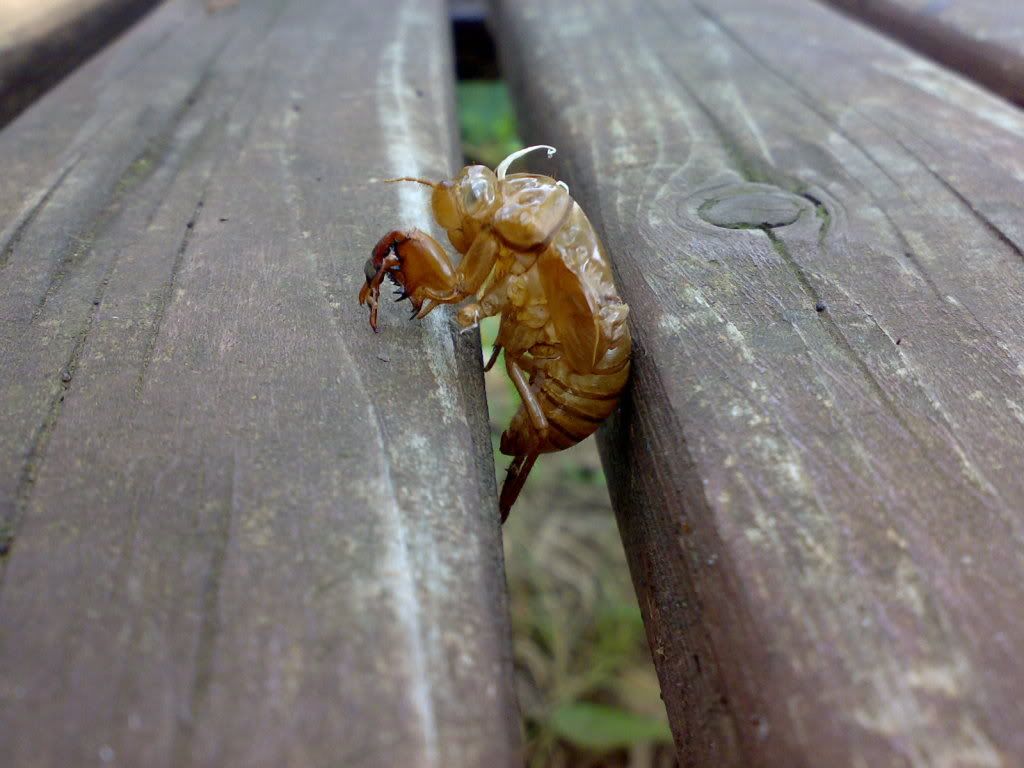
Cicadas are a popular symbol in Japanese literature and art. It comes out of the ground, moults and leaves its dry husk behind, sings for a brief season, mates and then dies. So it represents all their favorite themes of rebirth and brevity of life. What the cherry blossoms are for spring, cicada are for summer. Which possesses the greater beauty, however, is up for debate.

Tuesday, June 8, 2010

“and the public are warned to stay off…”

As unreliable as Wikipedia may be for research, it can be entertaining for casual purposes.


The only laugh game in town

Before television, audiences often experienced comedy, whether performed live on stage, on radio, or in a movie, in the presence of other audience members. Television producers attempted to recreate this atmosphere in its early days by introducing the sound of laughter or other crowd reactions into the soundtrack of television programs.

Historically, live audiences could not be relied upon to laugh at the correct moment. Other times, the audiences could laugh too long or too loud, sounding unnatural and forced or throwing off the performers' rhythms…

Douglass used a keyboard to select the style, gender and age of the laugh as well as a foot pedal to time the length of the reaction. Inside the padlocked concoction was an endless array of recorded chuckles, yocks, and belly laughs; exactly 320 laughs on 32 tape loops, 10 to a loop. Each loop contained 10 individual audience laughs spliced end-to-end, whirling around simultaneously waiting to be cued up.


“You're going out with whom?!

…in algebraic chess notation with "!?" showing an interesting move that may not be the best, and "?!" showing a dubious move that may be difficult to justify.

Speckter solicited possible names for the new character from readers. Contenders included rhet, exclarotive, and exclamaquest, but he settled on interrobang.

A reverse and upside down interrobang suitable for starting phrases in Spanish, Galician and Asturian is called by some a gnaborretni (interrobang backwards).

(The irony mark should also be in wider use – it would save many misunderstandings on the internet. I also love

several other innovative punctuation marks, such as the doubt point (Point de doute.svg), certitude point (Point de certitude.svg), acclamation point (Point d'acclamation.svg), authority point (Point d'autorité.svg), indignation point (Point d'indignation.svg), and love point (Point d'amour.svg).

In Japanese, BTW, the exclamation point is called the “surprise mark.” But they only use it when referring to English, and in the language itself they use sentence-ending particles – “ka” for a question, “yo” for emphasis, “ne” to request confirmation, and a bunch that are only used by males. One of my problems reading simple Japanese novels is the lack of punctuation or quotation marks, so it looks like rather impersonal.


It’s been deleted, but there was an entry on the Motif of harmful sensation:

a recurring idea in literature: physical or mental damage that a person suffers merely by experiencing what should normally be a benign sensation.

examples being Semele being destroyed by the true form of Zeus, the shrieking of a mandrake plant, Douglas Adams’ Vogon Poetry, Kate Bush’s song Experiment IV:

Monday, May 31, 2010

“No matter where you are…”

As one who bases a good deal of my worth and purpose on my expansive knowledge and love of literature, I’ve realized it’s a shame I know so little of my adopted country’s. I’d only read a small handful of Japanese classic novels before: Murakami Haruki’s Norwegian Wood, Mishima Yukio’s Sea of Fertility series, Endou Shusaku’s Scandal, Natsume Soseki’s I am a Cat, Dazai Osamu’s No Longer Human

But as I meet more people, and often get asked about my college, it becomes embarrassing to say that I was a comparative literature major and yet unable to talk in depth about it. I could rattle on about Russian literature, and have had a few nice moments of recognition with Japanese people who at least have heard of Tolstoy and Dostoevsky. I want to be able to return the favor, so I’m making a dedicated effort to work my way through other well-known works.

In America, I would never read an “I Novel,” unless maybe if it was a non-fiction memoir of someone I really liked. A first-person novel would never have been on my reading list. I can’t explain that prejudice, exactly, they just always struck me as awkward. In Japan, however, they are a integral genre, and manage to be less self-conscious and more subtle.

The other weekend I consumed Murakami’s The Wind-Up Bird Chronicle in a couple of sittings on a park bench. Now I’m on Yoshimoto Banana’s Goodbye Tsugumi:

“I guess when you’re out on the ocean and you see the piers way off in the distance, shrouded in mist, you understand this very clearly: No matter where you are, you’re always a bit on your own, always an outsider.”